


Counting down the days…
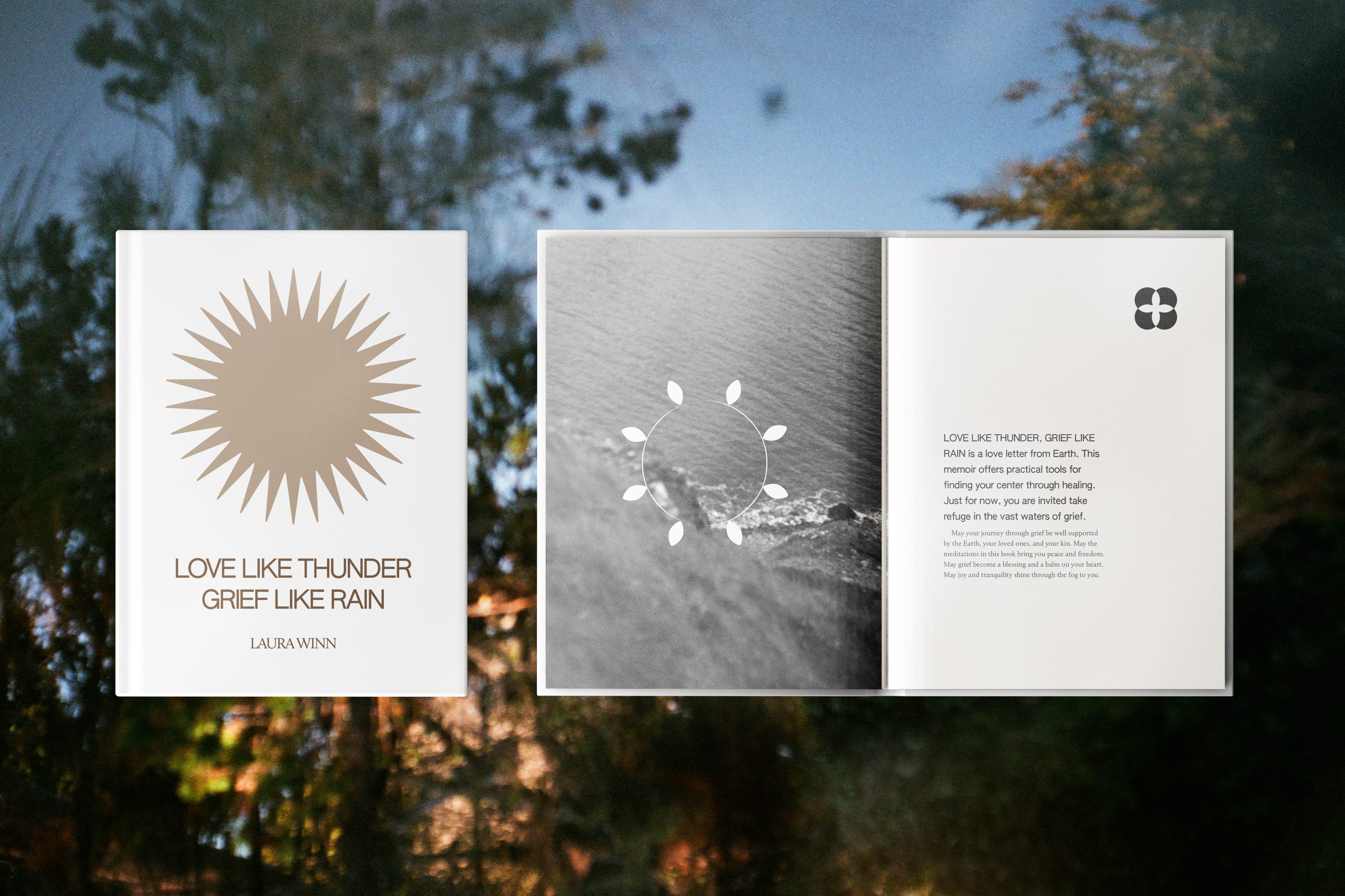
…till books go to print. Right now, I’m working with my printer on the final details. Plus, I’m dreaming up special gifts to go along with the launch. For now, I want to share a tease of the book. More than a tease, really.
A whole chapter.
Before we dive in, here is the first gift of the book: a playlist!
The “Love like Thunder, Grief like Rain” playlist is a celebration for me, and a preview of the emotional journey through the book. There are big feelings and quiet moments. There is room to access your rage and melodrama, then come back to center.
Without further ado, here is a proper book preview.
Chapter 6
Connecting to Grief
Meditation appeared in my life by chance. Months before my art residency in Iceland, Xiulung organized a spontaneous midwinter vacation for us. On a moment’s notice, we fled cold and rainy San Francisco to stay in Maui for a couple nights. In our rental house, sparkly sheets of colorful paper were stacked on a table by the door. HOW TO MEDITATE was printed across the top.
Perfectly imperfect with spelling mistakes and conflicting instructions, the sheet outlined an essential practice for mindfulness meditation. On our way home, I chose a yellow page from the stack, tucked it in my bag, and stored the paper away at home. Later that year, as I prepared for Thingeyri, my intuition nudged me to bring the instructions along like a talisman.
During the residency, I stayed in a summer cabin at the base of a mountain overlooking the fjord. To support my artistic process and make a genuine attempt at consistent actions, I designed a daily routine. I slept in a twin size bed, piled high with blankets, as late as my body needed. Tiptoeing around in the morning, I made coffee and toast to enjoy at the kitchen table. I practiced yoga slowly upstairs for twenty or thirty minutes. Meditation followed, and then my art practice for the day began. My introduction to mindfulness meditation made the concept of focus so achievable, I could enjoy a consistent practice without becoming discouraged.
As instructed, I practiced sitting on a chair with my feet firmly planted on the floor. Setting my phone aside, I avoided tracking the time. Instead of trying to control my thoughts or clear my mind, I allowed the practice to be boring. Resisting the urge to fidget, I let myself feel restless or calm without abandoning the sit early.
By staying with the practice of meditating for one minute every morning, I noticed my inner world starting to loosen like sand underfoot. I released unconscious limitations, without much effort, as my awareness flowed freely. I concentrated on my body’s natural rhythm of taking in air, and gently letting it go.
Whenever my mind wandered, I gently refocused my attention on my breath. Soon one minute turned to two, then two minutes expanded to five. Five minutes lingered to ten, until my meditation practice started to extend beyond the chair. As the tranquil days passed, mindful breathing began to weave a sense of presence in me.
On long walks with the residency dogs, I slowly observed the world around us: dewdrops quivering on pale green leaves, the sound of water caressing the round stones dotting the shoreline, the way tall grass would rustle on the hill behind our cabin, the massive winds rustling color-changing tree leaves as autumn progressed.
Max – my favorite dog – liked to climb the hill at the foot of the mountain behind our cabin with me. Together we would make our way up the slope with him bounding ahead, then waiting for me. When he was ready, he would find a place to sit in the tall grass overlooking the town. As Max watched the world, I observed his meditative nature. Side by side, we noticed the sights and sounds of the village. I wondered how much of the Earth around us he could smell: the mountain behind us, the water and life in the fjord below, people walking to the swim hall behind the church, roaming sheep in the hills, wild horses lingering nearby before scattering for winter. Spending time with Max taught me how to bring my senses fully to the world in each moment, rather than living in my mind.
In the coming years, meditating without ceasing became a central goal of my spiritual practice. Through the gift of presence, I slowly began to live my life as a meditation. When I tuned into my emotions, I found a sense of safety inside myself that I had been searching for all of my life. There was no longer a need to make the world different for my own comfort. I could finally surrender the parts of me grasping for love. When I sat still to hear the quiet space of my heart, love made its presence known with a flood of acceptance radiating through my being.
Conscious Focus
Grief guides us to shine our true essence into the world through our relationships. Self reflection is a vital practice that illuminates where our actions and ideals align. To that end, the curriculum of loss calls us to take inventory of our lives. Eventually the facets of grief we avoid – emotions we push away, relationship dynamics we ignore, certain truths we deny – overwhelm us in confrontation. Processing grief prompts us to counter our fear with love and trust. Even when we feel our experiences of grief and sorrow are unique, there are many people suffering on the road of life.
Avoiding Spiritual Traps
As I unraveled trauma, learning to ask for help is one of the first lessons in humility that emerged from my inner work. During an ayahuasca ceremony in deep winter I noticed my throat was tender, so I asked an assistant for a mug of hot water. For context this required a helper to leave the ceremony, go to the kitchen, boil fresh water, and then bring it to my mat in the dark. It was a slightly unusual request for a ceremony. I asked because I felt myself starting to get a sore throat, and did not want to get sick.
This small act of service given so freely is the kind of care in childhood that I longed for from my parents. Holding the warm mug moments later, I felt amazed at how asking for care could be so simple. Slowing down in gratitude, I made space to appreciate the water. Before taking a sip, I noticed my body. Feeling my warm hands and the dryness in my throat, I held this in my awareness for a moment. As I sipped the water, my body relaxed.
When strong emotions pull our attention away from the present moment, we miss the beauty of time passing. Distraction creates a ripple effect in our lives. If our minds are caught in a story about our emotions, then we are torn away from our essential nature. When our minds cling to pain, thoughts become amplified through our bodies. Our vital energy is depleted, like soil lacking nutrients.
Reiki teaches that awareness lives behind the eyes. To see for yourself, practice locating your awareness in meditation. There is no separation between us and the world. The unfolding labyrinth of our lives is one part of the collective conciousness, humanity, and the universe. Watching our breath shows us the way to be with the sensations, thoughts, and emotions constantly changing within us. Meditation allows us to witness our aliveness as part of our journey.
Watching the breath opens our awareness of thought, like a rose in bloom. Our thoughts form the frame we live our lives through. The way we speak to ourselves unconsciously hinders us from imagining our lives and possible futures. Narrow thoughts like, “A good life is possible for them, but that is not an option for me,” become the story of our lives. By creating reality in our minds, we shape our perspective in powerful ways.
As we investigate further we find that thoughts are conjured by subtle energy, or our subconscious minds. Energy creates a thought, a thought shapes an idea, and then an idea creates an emotion. We feel an emotional response that reinforces a story. Our beliefs form our worldview. In this way, the constant flow of energy, thoughts, and emotions converge to shape reality.
For years, we may live unaware of our minds and feelings. This is where grief throws cold water on us like a Zen monk in zazen. Life wakes us up to say, “Be real.” To choose the path of love and acceptance, we live through conscious action.
The first step is finding clarity about who we really are underneath the layered thoughts and identities. Like Max observing the hillside, our mindfulness practice opens our senses to take a long view of the world. Awareness is the true gift of meditation.
Turn to Earth
When we know grief is a milestone to honor rather than a problem to be solved, we move through loss with dignity. Regardless of our limitations, we share our hearts openly. Boundaries teach us how to be safely held in the grief process. By moving through the work of loss or trauma with integrity, we contribute to a new culture of care for ourselves and those around us.
When we neglect to tend our grief like an overgrown garden, the tangled force of grief can linger for years. Wandering through the fog of loss steals precious time away from our lives. Losing time might look like burying our emotions, becoming overly attached to resentment, or keeping ourselves too occupied to grieve. As we turn the stones of memory over and over in our minds, we search for a gem – one tiny insight to make sense of our grief.
The beauty of the world is that we are never alone. Love surrounds us in every breath. Our planet is a portal to the cosmic wonder of life. Bringing our grief to the Earth clears a new path for us to heal. Sense the magic of nature in sunlight glittering through tree canopies, the sound of branches clattering together every winter, fireflies illuminating dusk on rich summer nights, and soft winds dancing around us. Opening our awareness toward the Earth supports our resistance to grief and invites us to feel love.
Connection is a conversation between us and nature. Earth is there for us when our loved ones are busy, it’s too late at night to call, or we feel shame about needing extra support. Moving through loss can feel shaky. Vulnerability might be a risk. Maybe the story we tell ourselves is that our grief is too much of a burden to share with others. In all scenarios the Earth holds us, absorbing our worries. Through every season of grief, nature is our support.
Practicing Compassion
As you move through loss, turn inward for compassion. Compassion is a circling spiral of love for the wellbeing of yourself and others. If you practice empathy then imagine your feelings of care growing even deeper, like ancient tree roots in soil. Compassion guides you toward your heart to love with awareness.
Compassionate meditation shows us how to strengthen our concern and support for people around us. Dr. Helen Weng, a clinical psychologist from the University of Wisconsin-Madison, developed a research-based meditation to teach compassion through the body. The meditation is shared with guided audio and written instructions on the Greater Good in Action website.
Like many aspects of personal growth, compassion may be easier to imagine in our minds than embody through action. Our knowledge is transformed by practice. First, we observe the contents of our heart in mindfulness. Later we build this skill by extending loving awareness to ourselves and those around us.
As we turn our gaze inward through meditation, mindfulness, therapy, and grief work, we are likely to discover new parts of ourselves that we may not like. For example, when we listen to our unfiltered thoughts, our thoughts could be overly harsh and critical. Depending on our personality, we might react strongly and overcorrect to help ourselves “improve” forever.
Embracing our insecurities and weaknesses is challenging work. Many of us are trapped in cycles we want to change – people pleasing, sleeping too little, ignoring our capacity, holding onto resentment, giving too much or too little, eating poorly, and generally neglecting our needs. If we feel overwhelmed, then we may give up on seeking support before we even try.
Developing compassion for ourselves is a way through the blocks. Change begins with small, powerful adjustments to our daily lives, like making time to be in nature. Grounding is a path to acceptance and embracing ourselves how we are in this moment. To come back to center, return to the Grounding Meditation in Chapter 3.
*
Many people who begin to unearth trauma find that facing the past is a daunting and uncomfortable experience. There is an impulse either run from the pain in denial, or lunge into the darkness with intense focus. Somewhere deep inside, a primal instinct compels us to delve deeper into the mystery. Our inner nature finds balance in grief, like stacking stones in a cairn.
Setting limits for ourselves around our healing work is a way to heal grief sustainably. When we acknowledge suffering, a part of us sighs in relief. We create enough space to support ourselves through discomfort. Sometimes we need to take breaks and pace ourselves.
Grief transforms us on the timeline of wisdom. When we devote ourselves to practices like mindfulness, meditation, and being in nature, we create a calm pool that replenishes us. Peace begins to flow from us naturally, where the creek meets the wide mouth of the river. We are soft Earthen clay in grief’s caring hands, molding our hearts into the shape of compassion.
There is no magic elixir for healing grief and trauma, or divine mantra that instantly resolves our inner turmoil. All we need to do is remember that we are capable of feeling peace. Our true nature is calm. Parts of our lives disrupt our tranquil surface, like ripples across calm water. Practices that support our wellbeing are paths to cultivating presence for the vast challenges and vibrant joys in life.
Taking Inventory
Create a snapshot of the ways you take care of yourself now. This set of questions is designed to help you draw your own conclusions about how compassion is present in your life today. Capture your answers in writing or silent reflection.
Do I take care of myself with respect?
Am I open to love in all its forms?
Do I live from my heart?
*
Release Meditation
This meditation is designed for times when you feel scattered or restless. You could be feeling overwhelmed, or maybe you just need a break from your day. The way you are in this moment is changing – even while you read this sentence. Take a moment now to settle in, release the chatter of your busy mind, and calm your inner state.
*
Place your body in a comfortable position. You could be sitting in a chair, lying down on the ground, or supported by pillows. Rest where your body is most comfortable, and move when you need.
Begin to notice your breath. Notice how it feels to trace your breath to the present moment. Tune in to how you are feeling now.
You may be feeling irritation, anger, fear, or anxiety. Maybe loneliness, boredom, sadness, or stress are present. Bring your emotions to the surface of your awareness. Set your mind to locate sensation in your body. Create a map of how you feel inside.
Breathe into your body. Breathe out of your body.
What is coming up for you in this moment? Do you notice any strong or subtle emotions? Any sensations coming to the surface of your field may be ready to be released.
Give your stories, emotions, thoughts, and energetic material to the ground. Direct your exhale down toward the Earth. Focus your attention on nature. Let any emotions, thoughts, stories, feelings, or sensations pour out of your body.
Say to yourself:
I release this feeling. I release this story. I release this pattern.
Breathe until you feel complete. Your state of being may be lighter than it was before. When you are ready, slowly move to awaken your body. Transition from this meditation state to your environment. Notice the world around you. Sense the world inside you. You are invited to journal, draw, or share your experience with a friend.
Thank you for reading and if you made it this far in the post, congratulations! You are invited to take a moment to sign up to be notified when pre-orders go live and here’s that playlist link again. Take care of yourself.